

Which Of The Following Statements About The First Step Of The Line Drawing Technique Are Incorret
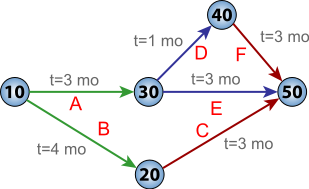
PERT network chart for a 7-calendar month project with five milestones (10 through l) and six activities (A through F).
The plan (or project) evaluation and review technique (PERT) is a statistical tool used in project management, which was designed to clarify and represent the tasks involved in completing a given projection.
First developed by the Us Navy in 1958, information technology is commonly used in conjunction with the disquisitional path method (CPM) that was introduced in 1957.
Overview [edit]
PERT is a method of analyzing the tasks involved in completing a given project, especially the time needed to complete each task, and to place the minimum time needed to consummate the full project. It incorporates uncertainty by making it possible to schedule a projection while non knowing precisely the details and durations of all the activities. It is more than of an consequence-oriented technique rather than first- and completion-oriented, and is used more in those projects where time is the major cistron rather than toll. It is applied on very big-calibration, one-time, complex, non-routine infrastructure and on Research and Development projects.
PERT offers a management tool, which relies "on arrow and node diagrams of activities and events: arrows correspond the activities or piece of work necessary to reach the events or nodes that indicate each completed phase of the total projection."[1]
PERT and CPM are complementary tools, because "CPM employs ane time interpretation and one cost estimation for each activity; PERT may utilize three time estimates (optimistic, expected, and pessimistic) and no costs for each activity. Although these are distinct differences, the term PERT is applied increasingly to all critical path scheduling."[1]
History [edit]
"PERT" was developed primarily to simplify the planning and scheduling of large and complex projects. It was adult for the U.S. Navy Special Projects Part in 1957 to support the U.S. Navy's Polaris nuclear submarine projection.[two] Information technology found applications all over industry. An early on case is when it was used for the 1968 Winter Olympics in Grenoble which applied PERT from 1965 until the opening of the 1968 Games.[3] This project model was the first of its kind, a revival for scientific direction, founded by Frederick Taylor (Taylorism) and later refined by Henry Ford (Fordism). DuPont's critical path method was invented at roughly the same fourth dimension equally PERT.

PERT Summary Report Stage two, 1958
Initially PERT stood for Programme Evaluation Research Job, but by 1959 was already renamed.[2] It had been made public in 1958 in 2 publications of the U.S. Section of the Navy, entitled Program Evaluation Research Job, Summary Report, Phase 1. [4] and Phase 2. [five] In a 1959 article in The American Statistician the main Willard Fazar, Head of the Plan Evaluation Branch, Special Projects Office, U.S. Navy, gave a detailed description of the main concepts of the PERT. He explained:
Through an electronic figurer, the PERT technique processes data representing the major, finite accomplishments (events) essential to reach cease-objectives; the inter-dependence of those events; and estimates of time and range of fourth dimension necessary to consummate each activity between two successive events. Such time expectations include estimates of "most likely fourth dimension", "optimistic fourth dimension", and "pessimistic time" for each action. The technique is a direction control tool that sizes up the outlook for meeting objectives on time; highlights danger signals requiring direction decisions; reveals and defines both methodicalness and slack in the flow program or the network of sequential activities that must be performed to meet objectives; compares current expectations with scheduled completion dates and computes the probability for meeting scheduled dates; and simulates the effects of options for decision — before decision.
The concept of PERT was developed by an operations enquiry team staffed with representatives from the Operations Research Department of Booz Allen Hamilton; the Evaluation Part of the Lockheed Missile Systems Division; and the Program Evaluation Branch, Special Projects Part, of the Department of the Navy.[half dozen]

PERT Guide for management use, June 1963
Ten years after the introduction of PERT in 1958 the American librarian Maribeth Brennan published a selected bibliography with most 150 publications on PERT and CPM, which had been published betwixt 1958 and 1968. The origin and evolution was summarized as follows:
PERT originated in 1958 with the ... Polaris missile design and structure scheduling. Since that time, information technology has been used extensively not only by the aerospace industry but also in many situations where management desires to achieve an objective or complete a chore within a scheduled time and cost expenditure; it came into popularity when the algorithm for computing a maximum value path was conceived. PERT and CPM may be calculated manually or with a computer, simply usually they require major computer support for detailed projects. A number of colleges and universities now offering instructional courses in both.[1]
For the subdivision of work units in PERT[seven] some other tool was developed: the Work Breakdown Structure. The Work Breakdown Structure provides "a framework for complete networking, the Work Breakup Structure was formally introduced equally the first item of analysis in carrying out basic PERT/Cost."[eight]
Terminology [edit]
Events and activities [edit]
In a PERT diagram, the main building block is the issue, with connections to its known predecessor events and successor events.
- PERT event: a point that marks the start or completion of i or more activities. Information technology consumes no time and uses no resources. When it marks the completion of i or more activities, it is not "reached" (does non occur) until all of the activities leading to that event have been completed.
- predecessor issue: an upshot that immediately precedes some other effect without any other events intervening. An event can have multiple predecessor events and can be the predecessor of multiple events.
- successor result: an effect that immediately follows some other event without any other intervening events. An upshot can have multiple successor events and can be the successor of multiple events.
Too events, PERT also knows activities and sub-activities:
- PERT activity: the actual operation of a task which consumes time and requires resources (such as labor, materials, space, machinery). It tin be understood equally representing the time, effort, and resource required to move from one issue to another. A PERT activity cannot be performed until the predecessor event has occurred.
- PERT sub-activity: a PERT activity tin be further decomposed into a prepare of sub-activities. For example, action A1 tin can be decomposed into A1.1, A1.2 and A1.3. Sub-activities accept all the properties of activities; in particular, a sub-activity has predecessor or successor events simply like an activity. A sub-activeness can be decomposed over again into finer-grained sub-activities.
Time [edit]
PERT has divers four types of time required to reach an activity:
- optimistic time: the minimum possible time required to accomplish an activity (o) or a path (O), assuming everything gain meliorate than is normally expected
- pessimistic time: the maximum possible time required to achieve an activity (p) or a path (P), assuming everything goes incorrect (only excluding major catastrophes).
- most probable fourth dimension: the best gauge of the fourth dimension required to accomplish an activity (thou) or a path (M), assuming everything proceeds as normal.
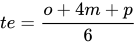
- expected time: the all-time estimate of the time required to accomplish an action (te) or a path (TE), accounting for the fact that things don't always keep equally normal (the implication existence that the expected time is the boilerplate fourth dimension the task would require if the task were repeated on a number of occasions over an extended period of time).
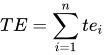
- standard divergence of fourth dimension : the variability of the fourth dimension for accomplishing an activity (σte) or a path (σTE)
![{\displaystyle {\begin{aligned}&\sigma _{te}={\frac {p-o}{6}}\\[8pt]&\sigma _{TE}={\sqrt {\sum _{i=1}^{n}{\sigma _{te_{i}}}^{2}}}\end{aligned}}}](https://wikimedia.org/api/rest_v1/media/math/render/svg/9b8f0591db32c23b563de325fbda071969eefed4)
Management tools [edit]
PERT supplies a number of tools for direction with decision of concepts, such as:
- float or slack is a measure out of the backlog fourth dimension and resource available to complete a job. It is the amount of fourth dimension that a project task can exist delayed without causing a delay in whatsoever subsequent tasks (gratis float) or the whole project (total bladder). Positive slack would indicate alee of schedule; negative slack would indicate backside schedule; and zero slack would indicate on schedule.
- disquisitional path: the longest possible continuous pathway taken from the initial event to the terminal event. It determines the total calendar time required for the projection; and, therefore, any fourth dimension delays forth the critical path volition delay the reaching of the terminal event by at least the aforementioned corporeality.
- critical activity: An activity that has total float equal to cypher. An activity with zero free bladder is not necessarily on the disquisitional path since its path may not be the longest.
- atomic number 82 fourth dimension: the time past which a predecessor upshot must exist completed in order to let sufficient time for the activities that must elapse before a specific PERT event reaches completion.
- lag fourth dimension: the earliest fourth dimension by which a successor event tin follow a specific PERT event.
- fast tracking: performing more critical activities in parallel
- crashing disquisitional path: Shortening duration of critical activities
Implementation [edit]
The first stride for scheduling the projection is to determine the tasks that the project requires and the social club in which they must exist completed. The society may exist easy to record for some tasks (e.thou., when building a house, the state must be graded before the foundation can be laid) while difficult for others (there are two areas that need to be graded, but there are only enough bulldozers to practice one). Additionally, the time estimates usually reflect the normal, non-rushed fourth dimension. Many times, the fourth dimension required to execute the task can be reduced for an boosted cost or a reduction in the quality.
Case [edit]
In the following example there are vii tasks, labeled A through G. Some tasks can be done concurrently (A and B) while others cannot be done until their predecessor task is complete (C cannot begin until A is complete). Additionally, each task has three fourth dimension estimates: the optimistic time estimate (o), the nigh likely or normal time approximate (m), and the pessimistic fourth dimension guess (p). The expected time (te) is computed using the formula (o + 4g + p) ÷ 6.
| Activity | Predecessor | Fourth dimension estimates | Expected time | ||
|---|---|---|---|---|---|
| Opt. (o) | Normal (chiliad) | Pess. (p) | |||
| A | — | ii | 4 | 6 | four.00 |
| B | — | 3 | 5 | 9 | 5.33 |
| C | A | 4 | five | 7 | 5.17 |
| D | A | 4 | half dozen | 10 | half-dozen.33 |
| E | B, C | four | five | vii | 5.17 |
| F | D | iii | 4 | 8 | 4.50 |
| Thousand | E | iii | 5 | 8 | 5.17 |
Once this step is complete, one can draw a Gantt chart or a network diagram.
-
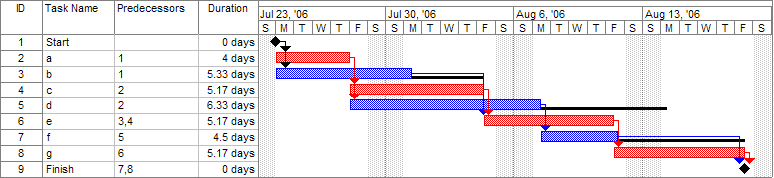
A Gantt chart created using Microsoft Project (MSP). Note (1) the critical path is in ruddy, (two) the slack is the blackness lines connected to not-critical activities, (iii) since Saturday and Sunday are non work days and are thus excluded from the schedule, some bars on the Gantt chart are longer if they cutting through a weekend.
-
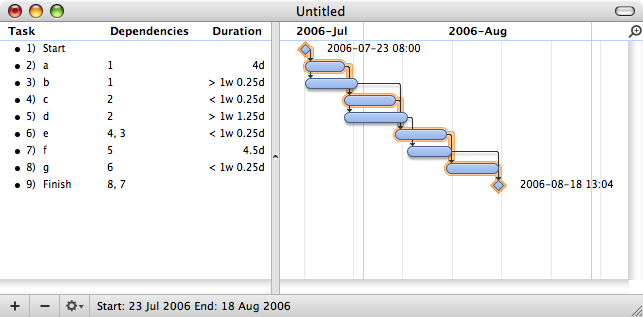
A Gantt chart created using OmniPlan. Note (1) the critical path is highlighted, (2) the slack is not specifically indicated on task 5 (d), though information technology tin be observed on tasks 3 and 7 (b and f), (3) since weekends are indicated by a thin vertical line, and take up no additional space on the work calendar, bars on the Gantt chart are not longer or shorter when they do or don't carry over a weekend.
Next step, creating network diagram by hand or past using diagram software [edit]
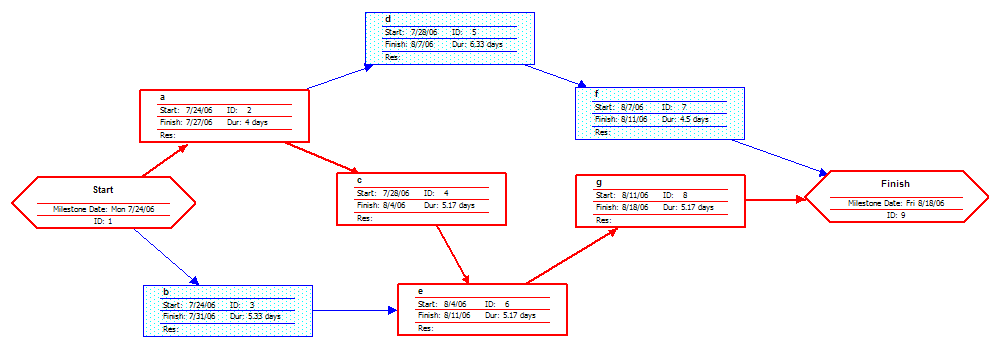
A network diagram can be created past mitt or by using diagram software. In that location are two types of network diagrams, activity on arrow (AOA) and activity on node (AON). Activity on node diagrams are mostly easier to create and translate. To create an AON diagram, it is recommended (but not required) to starting time with a node named start. This "activity" has a duration of goose egg (0). Then you lot draw each activity that does not have a predecessor activity (a and b in this example) and connect them with an arrow from beginning to each node. Adjacent, since both c and d list a as a predecessor activity, their nodes are drawn with arrows coming from a. Activity due east is listed with b and c as predecessor activities, so node east is drawn with arrows coming from both b and c, signifying that due east cannot brainstorm until both b and c have been completed. Activity f has d every bit a predecessor activity, then an pointer is fatigued connecting the activities. Likewise, an arrow is drawn from east to g. Since there are no activities that come after f or one thousand, it is recommended (only once more non required) to connect them to a node labeled cease.
-

A node like this 1 (from Microsoft Visio) can exist used to brandish the activity proper noun, duration, ES, EF, LS, LF, and slack.
By itself, the network diagram pictured above does non requite much more information than a Gantt chart; nonetheless, information technology can be expanded to display more information. The nigh common data shown is:
- The activity name
- The expected duration time
- The early start time (ES)
- The early finish fourth dimension (EF)
- The tardily start time (LS)
- The belatedly finish fourth dimension (LF)
- The slack
In lodge to make up one's mind this information it is causeless that the activities and normal duration times are given. The first step is to decide the ES and EF. The ES is defined as the maximum EF of all predecessor activities, unless the activity in question is the first activity, for which the ES is cipher (0). The EF is the ES plus the task duration (EF = ES + duration).
- The ES for outset is nil since it is the first action. Since the duration is zero, the EF is as well zero. This EF is used as the ES for a and b.
- The ES for a is zero. The duration (4 piece of work days) is added to the ES to go an EF of four. This EF is used as the ES for c and d.
- The ES for b is zero. The duration (five.33 piece of work days) is added to the ES to get an EF of v.33.
- The ES for c is four. The elapsing (5.17 work days) is added to the ES to get an EF of ix.17.
- The ES for d is four. The duration (6.33 piece of work days) is added to the ES to become an EF of 10.33. This EF is used as the ES for f.
- The ES for due east is the greatest EF of its predecessor activities (b and c). Since b has an EF of 5.33 and c has an EF of ix.17, the ES of eastward is 9.17. The duration (5.17 work days) is added to the ES to become an EF of xiv.34. This EF is used as the ES for g.
- The ES for f is ten.33. The duration (4.5 work days) is added to the ES to get an EF of fourteen.83.
- The ES for g is fourteen.34. The duration (5.17 work days) is added to the ES to get an EF of nineteen.51.
- The ES for terminate is the greatest EF of its predecessor activities (f and one thousand). Since f has an EF of xiv.83 and k has an EF of 19.51, the ES of finish is 19.51. Finish is a milestone (and therefore has a elapsing of zero), and so the EF is also nineteen.51.
Disallowment any unforeseen events, the project should have 19.51 work days to consummate. The side by side step is to make up one's mind the belatedly start (LS) and late finish (LF) of each activity. This will eventually show if at that place are activities that take slack. The LF is defined as the minimum LS of all successor activities, unless the action is the last action, for which the LF equals the EF. The LS is the LF minus the chore duration (LS = LF − duration).
- The LF for finish is equal to the EF (19.51 work days) since it is the last activity in the project. Since the duration is zero, the LS is also 19.51 work days. This volition be used as the LF for f and g.
- The LF for one thousand is 19.51 piece of work days. The duration (five.17 work days) is subtracted from the LF to go an LS of 14.34 work days. This will exist used as the LF for e.
- The LF for f is 19.51 work days. The duration (iv.5 work days) is subtracted from the LF to get an LS of 15.01 work days. This will be used equally the LF for d.
- The LF for eastward is 14.34 work days. The elapsing (v.17 piece of work days) is subtracted from the LF to get an LS of ix.17 piece of work days. This will be used as the LF for b and c.
- The LF for d is 15.01 work days. The elapsing (6.33 work days) is subtracted from the LF to get an LS of eight.68 work days.
- The LF for c is 9.17 work days. The duration (5.17 piece of work days) is subtracted from the LF to get an LS of 4 work days.
- The LF for b is nine.17 piece of work days. The duration (5.33 work days) is subtracted from the LF to become an LS of three.84 work days.
- The LF for a is the minimum LS of its successor activities. Since c has an LS of 4 work days and d has an LS of viii.68 work days, the LF for a is 4 work days. The elapsing (4 work days) is subtracted from the LF to go an LS of 0 work days.
- The LF for outset is the minimum LS of its successor activities. Since a has an LS of 0 work days and b has an LS of iii.84 work days, the LS is 0 work days.
Next step, determination of disquisitional path and possible slack [edit]
The next step is to determine the critical path and if any activities take slack. The critical path is the path that takes the longest to consummate. To determine the path times, add together the task durations for all bachelor paths. Activities that have slack tin exist delayed without irresolute the overall time of the project. Slack is computed in ane of two ways, slack = LF − EF or slack = LS − ES. Activities that are on the critical path take a slack of nada (0).
- The duration of path adf is 14.83 work days.
- The duration of path aceg is nineteen.51 piece of work days.
- The elapsing of path beg is 15.67 work days.
The critical path is aceg and the critical time is 19.51 work days. It is of import to note that there tin be more than than one disquisitional path (in a project more complex than this example) or that the disquisitional path can change. For example, let'south say that activities d and f take their pessimistic (b) times to complete instead of their expected (TE) times. The critical path is now adf and the critical fourth dimension is 22 piece of work days. On the other hand, if activity c can be reduced to 1 work 24-hour interval, the path time for aceg is reduced to 15.34 work days, which is slightly less than the time of the new critical path, beg (15.67 work days).
Assuming these scenarios do not happen, the slack for each activity tin now exist adamant.
- Kickoff and end are milestones and past definition have no elapsing, therefore they tin take no slack (0 work days).
- The activities on the critical path by definition accept a slack of zero; nonetheless, information technology is e'er a good idea to check the math anyway when drawing by manus.
- LFa – EFa = 4 − 4 = 0
- LFc – EFc = 9.17 − 9.17 = 0
- LFeastward – EFe = 14.34 − 14.34 = 0
- LFg – EF1000 = 19.51 − 19.51 = 0
- Activeness b has an LF of ix.17 and an EF of 5.33, so the slack is iii.84 work days.
- Activity d has an LF of 15.01 and an EF of x.33, and so the slack is 4.68 work days.
- Action f has an LF of 19.51 and an EF of 14.83, and then the slack is 4.68 piece of work days.
Therefore, activity b can be delayed most 4 work days without delaying the project. Also, activity d or activity f tin be delayed 4.68 work days without delaying the project (alternatively, d and f can be delayed 2.34 work days each).

Fugitive loops [edit]
Depending upon the capabilities of the data input stage of the critical path algorithm, it may be possible to create a loop, such as A -> B -> C -> A. This can crusade simple algorithms to loop indefinitely. Although it is possible to "marking" nodes that have been visited, then clear the "marks" upon completion of the process, a far simpler mechanism involves computing the total of all activity durations. If an EF of more than the total is found, the computation should be terminated. Information technology is worth saving the identities of the most recently visited dozen or then nodes to help identify the problem link.
As project scheduling tool [edit]
Advantages [edit]
- PERT chart explicitly defines and makes visible dependencies (precedence relationships) between the work breakup structure (commonly WBS) elements.
- PERT facilitates identification of the critical path and makes this visible.
- PERT facilitates identification of early start, late start, and slack for each activeness.
- PERT provides for potentially reduced projection duration due to better understanding of dependencies leading to improved overlapping of activities and tasks where feasible.
- The large amount of project data can be organized and presented in diagram for use in decision making.
- PERT can provide a probability of completing before a given time.
Disadvantages [edit]
- There can be potentially hundreds or thousands of activities and private dependency relationships.
- PERT is not easily scalable for smaller projects.
- The network charts tend to be large and unwieldy, requiring several pages to print and requiring specially-sized paper.
- The lack of a timeframe on most PERT/CPM charts makes information technology harder to show condition, although colours can help, e.g., specific colour for completed nodes.
Uncertainty in projection scheduling [edit]
During project execution, however, a real-life projection will never execute exactly every bit it was planned due to incertitude. This can exist due to ambivalence resulting from subjective estimates that are prone to human errors or can exist the result of variability arising from unexpected events or risks. The main reason that PERT may provide inaccurate information about the project completion time is due to this schedule dubiety. This inaccuracy may be large enough to render such estimates as not helpful.
One possible method to maximize solution robustness is to include safety in the baseline schedule in order to absorb the anticipated disruptions. This is called proactive scheduling. A pure proactive scheduling is a utopia; incorporating rubber in a baseline schedule which allows for every possible disruption would pb to a baseline schedule with a very large make-span. A second arroyo, termed reactive scheduling, consists of defining a procedure to react to disruptions that cannot be absorbed by the baseline schedule.
Run into likewise [edit]
- Activeness diagram
- Arrow diagramming method
- PERT distribution
- Critical chain project direction
- Critical path method
- Float (project management)
- Gantt nautical chart
- GERT
- Precedence diagram method
- Project network
- Project management
- Project planning
- Triangular distribution
- PRINCE2
References [edit]
- ^ a b c Brennan, Maribeth, PERT and CPM: a selected bibliography, Monticello, Ill., Council of Planning Librarians, 1968. p. 1.
- ^ a b Malcolm, D. G., J. H. Roseboom, C. E. Clark, West. Fazar. "Application of a Technique for Research and Development Program Evaluation," OPERATIONS RESEARCH, Vol. 7, No. 5, September–October 1959, pp. 646–669
- ^ 1968 Winter Olympics official report. p. 49. Accessed 1 November 2022. (in English language and French)
- ^ U.S. Dept. of the Navy. Program Evaluation Research Task, Summary Report, Phase ane. Washington, D.C., Government Printing Role, 1958.
- ^ U.S. Dept. of the Navy. Program Evaluation Inquiry Task, Summary Written report, Phase 2. Washington, D.C., Regime Press Function, 1958.
- ^ Willard Fazar cited in: B. Ralph Stauber, H. M. Douty, Willard Fazar, Richard H. Hashemite kingdom of jordan, William Weinfeld and Allen D. Manvel. "Federal Statistical Activities." The American Statistician thirteen(2): nine-12 (Apr., 1959) , pp. ix-12
- ^ Desmond L. Cook (1966), Program Evaluation and Review Technique. p. 12
- ^ Harold Bright Maynard (1967), Handbook of Business Administration. p. 17
Further reading [edit]
- Project Management Establish (2013). A Guide to the Project Direction Body of Knowledge (5th ed.). Projection Management Institute. ISBN978-1-935589-67-nine.
- Klastorin, Ted (2003). Project Direction: Tools and Trade-offs (tertiary ed.). Wiley. ISBN978-0-471-41384-4.
- Harold Kerzner (2003). Projection Management: A Systems Approach to Planning, Scheduling, and Decision-making (8th ed.). Wiley. ISBN0-471-22577-0.
- Milosevic, Dragan Z. (2003). Projection Management ToolBox: Tools and Techniques for the Practicing Project Manager. Wiley. ISBN978-0-471-20822-8.
- Miller, Robert W. (1963). Schedule, Toll, and Profit Command with PERT - A Comprehensive Guide for Program Direction. McGraw-Hill. ISBN9780070419940.
- Sapolsky, Harvey M. (1971). The Polaris System Development: Bureaucratic and Programmatic Success in Government . Harvard University Press. ISBN0674682254.
External links [edit]
-
 Media related to PERT charts at Wikimedia Commons

Source: https://en.wikipedia.org/wiki/Program_evaluation_and_review_technique
Posted by: matterathationdeas02.blogspot.com
0 Response to "Which Of The Following Statements About The First Step Of The Line Drawing Technique Are Incorret"
Post a Comment