

How To Create A Great Product Roadmap
Ultimately, your product roadmap will help developers build the best product possible. With this in mind, here's a round-up of best practices from active, experienced product managers.
Best Practice #1: Present a Visual Product Roadmap.
An effective product roadmap will do more than 'tell:' it will also present a simple, realistic visual representation of your vision and how it is tied to company's goals. Additionally, your roadmap should be easy to understand and persuasive. PowerPoint and spreadsheets are widely used, but there are also many popular software options that make it easier to create visually compelling product roadmaps. For these reasons, many PMs prefer flexible task management tools like Trello, Jira, or Asana. Features such as swimlane views, drag-and-drop editors, movable cards, and other interactive features prevent presentations from coming off clunky.
Best Practice #2: Have Different Versions of Your Product Roadmap.
In his LinkedIn post, Google Developer Expert Shrinath V explains common difficulties in product roadmaps. If a sales team and dev team use the same roadmap, Sales might commit to a feature in order to close a deal without consulting the developers on timing or probability. This is just one of many problems that can occur if there is one party making changes or if you don't have a way to track who is making changes.
Remember, your roadmap helps you gain buy-in. Because each internal department has a unique role in helping make your product successful, each department will also care about something different. For example, marketing departments typically want to understand how product features will look and behave, while Sales wants details about when the product will be ready for customers to purchase it. To avoid publishing hard dates that could change, speak in terms of quarters or months.
"Don't fall into the trap of specifying dates for anything that's not already a work-in-progress or that isn't well defined and well understood. Any attempt to set a date for something that's outside the 1-3 month time horizon is not only a mistake, but is bound to fail," adds Gilley.
Each of the following product roadmaps were created in Smartsheet, and display timeframes instead of specific dates.
Example:

Example:
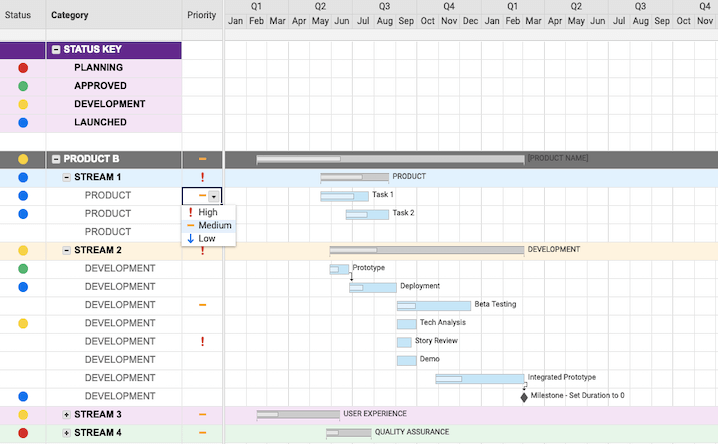
External product roadmaps are usually shared with company investors, industry analysts, customers, and the media. Even so, there's no one-size-fits-all approach. Gilley advises that for internal roadmaps that you intend to share with customers you want your product roadmap to reflect sufficient details without tipping your hand to any specific strategies that you're considering. For an external roadmap that you plan to share with investors, you should convey your strategic thinking and be structured in a way that presents confidence but still leaves doors open for innovation and agile responsiveness, without jeopardizing your financing rounds.
Below is an example of an external roadmap format:

Best Practice #3: Share Your Product Roadmap.
"The primary reason we want the product roadmap to be visible to anyone in the organization is that product roadmaps represent the plan of execution against the company vision and strategy," says Gilley.
As explain, product roadmaps organize and communicate a lot of information: what your development team is building, the problem the product will fix, as well as the business goals your product aspires to achieve. This means that your road map has the opportunity to speak directly to external or internal concerns and paint a clear picture of your intentions.
To executives, the roadmap validates your product's usefulness to a market that aligns with the organization's strategic direction, and also proves that it enhances the company's position. To your development team, your roadmap demonstrates progress and fosters inspiration. And to other internal departments—sales and marketing—your product roadmap sets expectations about product benefits, its comparisons to other similar products, and the potential for conversions.
To external customers, a product roadmap shows that you value their input and care about their needs. By sharing a roadmap externally, you signal that their awareness is a crucial part of your product's success, which increases the likelihood of purchase. Additionally, it's an opportunity to engage with customers and emphasize your brand story.
Janna Bastow, co-founder of ProPad and Mind the Product, explains the strategy behind their roadmaps. "Our product roadmap has actually become a central part of the way we communicate our priorities with our customers," she says. "Customers love the transparency. We've found that as long as we're open and honest about our priorities, customers are actually very forgiving. We hold onto the feedback we get and reach back into it to guide the way we approach their problems – and our customers know that."
It's true. ProPad's product roadmap for a web application is online for the digital world to see. Additionally, the site prompts visitors to share constructive feedback.
"When the roadmap is hidden," says Gilley, "the narratives about where the product is going, when, and why, are now outside of the control of the product manager and directly in the hands of the rumor mill and office grapevine."
Best Practice #4: Create a Flexible Roadmap
Todd Olson, Founder and CEO of Pendo, recommends that you write "SUBJECT TO CHANGE" on all product roadmaps. Maintaining flexibility in your timeline and deliverables will enable your team to react calmly to roadblocks, and to adapt your plan to fit changing needs. However, keep in mind that a product roadmap should have a single owner - this individual is the only person with the authority to add and remove items.
Best Practice #5: Involve Your Stakeholder Community in Regular Intervals.
Product roadmaps are created with the intention to be shared with internal development teams and others who have a role in the product's success. Rather than being static, your roadmap should function like a reader board that gives a current snapshot of project status. So, in order for your product roadmap to do its job well, it needs consistent input from the product owner. This means updating your roadmap daily to capture any market changes, new planning directions, added resources, or changes in priorities. By regularly updating your roadmap, you help your constituents understand factors that account for your product's progress or delays.
Karthik Vijayakumar, podcaster, author, and product maker at Design Your Thinking, asserts that continual updates also create a deep level of shared ownership that in turn drives results. "Without this," he says, "product roadmaps end up in nice documents without having seen the daylight".
Best Practice #6: Spend 10 Minutes with Your Product Roadmap.
Carving out chunks of time helps you identify trends and set priorities. Before checking email or cruising Twitter, give your product roadmap your entire focus. Sameena Velshi, Head of Product at Roadmunk, makes it her morning ritual. "Since I started allocating a few minutes to my roadmap every morning, my days have been more grounded. I analyze both the granular (what is each dev working on today? how close are we to that next release?), and the big picture (are we on track to make quarterly goals in line with our STRATEGY?)," she says. "It's given me a new sense of control and perspective over our approach to product management."
How To Create A Great Product Roadmap
Source: https://www.smartsheet.com/best-practices-and-expert-tips-creating-product-roadmaps
Posted by: matterathationdeas02.blogspot.com
0 Response to "How To Create A Great Product Roadmap"
Post a Comment